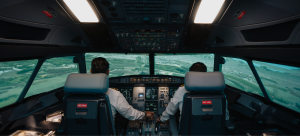

Professional pilots, especially those who work for commercial airlines, train using professional flight simulators that accurately reproduce the real conditions of flight.
These advanced devices allow pilots to practice maneuvers, procedures and emergency situations without risking lives or aircraft. In this guide, we explore which simulators they use, how they are designed and the different types available according to their purpose.
What is a professional flight simulator?
Definition and main components
A professional flight simulator is a highly advanced technological system that faithfully reproduces the experience of flying an aircraft. It is specifically designed for pilot training, both in the initial stages and during recurrent training sessions.
Its main components include:
-
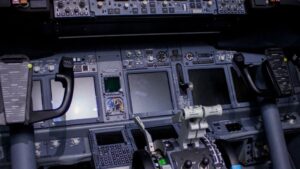
Realistic cockpit: An exact replica of aircraft models such as the Airbus flight simulator, the Boeing flight simulator or the ATR FFS, with all operational controls.
-
Immersive visual system: Panoramic screens that simulate real environments with 180° or 360° views.
- Motion platform: Recreates accelerations, turbulence and maneuvers.
- Avionics and navigation systems: Identical to those found in real aircraft.
- Instructor station: Allows control of the training environment, the introduction of failures and the evaluation of performance.
This type of simulator is considered the most realistic flight simulator available in the aviation industry.
Types of flight simulators according to their use
Flight simulators are mainly classified into two categories:
- Full Flight Simulator (FFS) :
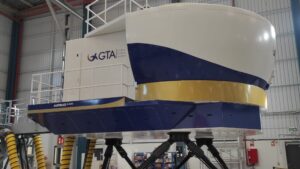
The most complete simulator with official certification for professional training. It includes motion, surround sound and high‑fidelity visuals. It is used for type ratings and recurrent training. Common examples are the A320 FFS, B737 FFS, ATR 500 and ATR 600 FFS.
- Flight Training Device (FTD) :
Simpler simulators without motion platforms but equipped with realistic cockpits and visual systems. Ideal for training procedures, navigation and preparation for certification. The most common models include VPT and FNPT.
Both types are essential for the training of airline pilots in flight simulators and are used in specialized centres such as Global Training Aviation, which offers professional flight simulators for airline pilots in Spain and around the world.
Why do pilots train in flight simulators?
The use of professional flight simulators in pilot training is not only common but essential. These advanced devices allow pilots to train in controlled, safe and highly realistic environments, improving their preparation for any situation that may arise during a real flight.
Safety and risk reduction
One of the main reasons for training in flight simulators is safety. In these virtual environments, instructors can simulate technical failures, adverse weather conditions or medical emergencies without putting human lives or real aircraft at risk.
Simulator‑based training allows the repetition of complex maneuvers, the practice of landings in extreme conditions and decision‑making in real time. This significantly reduces the risks during actual flights and improves the pilot’s ability to respond to unforeseen events.
Training in extreme conditions
Full flight simulators (FFS) and flight training devices (FTD) allow the recreation of scenarios that would be impossible or dangerous to practice in a real flight: thunderstorms, engine failures, forced landings, etc.
Thanks to the advanced technology of simulators such as the A320 FFS, B737 FFS or ATR FFS, pilots can train in extreme conditions with complete safety.
This type of preparation is crucial for airline pilots, who must be prepared to face any situation during operations.
Improving efficiency and reducing costs
Beyond safety, the use of flight simulators helps to optimize resources. Training in simulators reduces operating costs by avoiding the use of real aircraft, fuel and airspace.
Centres such as Global Training Aviation offer training programmes for airline pilots using flight simulators, enabling intensive, efficient and cost‑effective practice. This benefits both airlines and pilots, who gain access to more training hours in less time.
Main flight simulators used by pilots
Pilots, especially those who work for commercial airlines, train on certified simulators that accurately reproduce real flight conditions.
The most used are the Full Flight Simulators (FFS) and the Flight Training Devices (FTD), each with specific characteristics according to the type of training required.
Full Flight Simulator (FFS)
The Full Flight Simulator is the most advanced and comprehensive simulator. It is certified for official training and type ratings. Its main features include:
- A realistic cockpit with all functional controls.
- A high‑definition immersive visual system.
- A motion platform with six degrees of freedom.
- Ambient sound that simulates flight conditions.
This simulator allows the training of pilots under extreme conditions, simulating technical failures, adverse weather and emergency procedures.
Flight Training Device (FTD)
The flight training device, as mentioned earlier, is simpler and is used mainly for:
- Training on procedures before FFS sessions.
- Practice of navigation and communication.
- Preparation for theoretical and practical examinations.
Although it does not offer the same level of immersion as an FFS, the FTD is an effective and economical tool for pilot training, especially during the initial stages.
Most common simulator models used by airlines
Airlines generally use simulators specific to the aircraft they operate. The most common models include:
- A320 FFS: Used by airlines operating the Airbus A320, one of the most popular short‑ and medium‑haul aircraft.
- B737 FFS: Simulator of the Boeing 737, widely used by airlines around the world.
- ATR FFS: Simulator for the ATR 72, ideal for regional flights.
Flight simulators in pilot training
Training in flight simulators is essential in the professional training process. Thanks to technological advances, simulators can accurately reproduce all phases of flight, from engine start‑up to landing in extreme conditions. This methodology ensures that pilots are prepared to operate safely and efficiently in any situation.
Training stages
Simulator training is divided into several stages, tailored to the pilot’s level of experience and the type of aircraft they will operate. These stages include:
- Cockpit familiarization: Use of a flight training device (FTD) to learn systems and controls.
- Normal procedures: Practice of take‑offs, landings, navigation and communication.
- Abnormal and emergency procedures: Training in a Full Flight Simulator (FFS) to simulate technical failures, adverse weather and critical decision‑making.
- Recurrent evaluations: Periodic simulations to maintain type ratings and comply with safety standards.
Simulation of emergency procedures
One of the greatest advantages of training in flight simulators is the possibility of practicing emergency situations without real risks. The scenarios may include:
- Engine failures
- Onboard fires
- Cabin depressurization
- Forced landings in adverse conditions
These scenarios are carried out in simulators such as the A320 FFS, B737 FFS or ATR FFS, which provide an immersive and realistic experience. This type of training improves pilots’ reaction capacity and strengthens decision‑making under pressure.
Collaboration and coordination of the cockpit crew
Beyond technical skills, simulators promote teamwork in the cockpit. Pilots train alongside co‑pilots and instructors, developing communication, coordination and leadership skills. Collaboration among crew members is key to ensuring flight safety.
This training is especially important in commercial aviation, where every decision must be coordinated and executed with precision.
Which is the most realistic flight simulator?
The most realistic flight simulator is the Full Flight Simulator (FFS). It is considered the highest standard because:
- It faithfully reproduces the cockpit of real aircraft such as the A320 FFS, B737 FFS or ATR FFS.
- It includes a motion platform that simulates accelerations, turbulence and maneuvers.
- It offers a high‑definition immersive visual system.
- It allows training in normal and emergency procedures with total precision.
FAQ
What simulators do airline pilots use?
Airline pilots train mainly on Full Flight Simulators (FFS), such as the A320 FFS, B737 FFS or ATR FFS, which offer an immersive experience and are certified for official training.
They also use Flight Training Devices (FTD) to practice procedures and navigation, especially in the early stages of type ratings.
What is the best simulator for new pilots?
For new pilots training on commercial aircraft, the best simulator depends on the type of aircraft they will operate. Recommended models include:
- A320 FFS: Ideal for training on the Airbus A320, common on short and medium‑haul flights.
- B737 FFS: Perfect for pilots preparing to fly the Boeing 737, widely used by airlines worldwide.
- ATR FFS: Recommended for training on regional flights with turboprop aircraft such as the ATR 72.
How much does a professional flight simulator cost?
The price of a professional flight simulator varies according to the model and the level of realism. A full flight simulator can cost between 8 and 15 million euros, while a flight training device (FTD) is significantly less expensive.
Centres such as Global Training Aviation offer access to these simulators without the need to purchase them.