
Technology is important. But it is not enough.
Modern aviation operates in an increasingly complex, dynamic and automated environment. As a result, aviation training has also evolved significantly over recent decades.
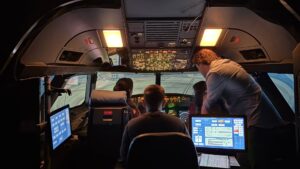
Today, virtually any modern aviation training school is equipped with advanced simulators, digital classrooms and state-of-the-art technology. In fact, in order to deliver certified programs such as a Type Rating, it is essential to have Full Flight Simulators (FFS) Level D, the highest certification available.
However, when two pilots complete exactly the same course, the outcomes are not always the same.
Because the difference is not only in the technology.
The difference lies in how it is taught.
Two pilots may train in the same flight simulator, attend the same classes and complete exactly the same training program. Yet one may simply memorize procedures while the other develops operational judgment, analytical skills and the confidence to handle complex real-world situations.
Technology facilitates learning.
Methodology is what transforms it.
Technology is essential, but no longer a differentiating factor
At Global Training Aviation, we strongly believe in the value of technology. As part of Indra, one of the world’s leading flight simulator manufacturers, we work with some of the most advanced tools in the sector and actively contribute to the evolution of training devices used for pilots and crew.
Our fleet includes different types of simulators and training devices designed to support students throughout all stages of their training:
-Full Flight Simulator (FFS) Level D
-Flight and Navigation Procedures Trainer (FNPT)
-Virtual Procedure Trainer (VPT)
-Cabin Emergency Evacuation Trainer (CEET)
However, having advanced simulators is not enough.
In fact, one of the most common mistakes is to assume that all learning takes place inside the Full Flight Simulator.
The reality is very different.
Although regulations require the use of Level D FFS to certify an Airbus A320, Boeing 737 or ATR 500 / ATR 600Type Rating, our experience has shown that training is much more effective when students start developing procedures, automatisms and operational understanding well before reaching that phase.
That is why at GTA we use a progressive combination of training devices. When a pilot has practiced procedures in a VPT, become familiar with systems in an FNPT, and built a solid foundation before entering the Full Flight Simulator, the transition is much more natural and learning becomes significantly more effective.
Technology is an extraordinary tool.
But it is still just a tool.
On its own, it does not guarantee better results.
The problem with training based solely on memorization
For many years, much of aviation training has been primarily focused on delivering knowledge, memorizing procedures and passing assessments.
In many pilot training programs, the main objective remains to complete the course, pass the Skill Test and obtain the corresponding rating.
While these goals are important, modern operational reality demands much more.
Airlines do not need pilots who are only capable of recalling procedures.
They need professionals who can analyze situations, manage threats and errors, communicate effectively, work as a team and make sound decisions under pressure.
The question is no longer simply:
Can this pilot execute the procedure?
The real question is:
Does the pilot understand what is happening and are they able to make the best possible decision?
The difference between these two questions defines the difference between training to pass an exam and training for a professional career.
It was precisely in response to this need that GTA developed ACT! (Aviation Collaborative Training), its own methodology based on collaborative learning, the development of cognitive skills and the active participation of the student throughout the entire training process.
ACT! is built on a very simple idea:
We do not work for the student. We work with the student.
The human factor remains key
At a time when technology dominates much of the conversation, it is easy to forget something essential: training remains a deeply human activity.
At GTA, the human factor does not begin in the simulator.
It begins from the very first contact.
From the moment a prospective student requests information, there is a team of people guiding, supporting and helping them throughout their training journey.
The same philosophy is applied to training.
Today, GTA has an international network made up of hundreds of instructors, many of whom are active pilots currently flying for airlines around the world.
They bring different experiences, knowledge and perspectives.
And this raises an important question:
How can a student receive a consistent training experience regardless of the instructor guiding them throughout the course?
The answer lies in one of the least visible, yet most important elements of any modern training organization: standardization.
Much more than instructors: a structure designed to teach
The quality of training does not depend solely on the instructor entering the simulator.
Behind every course there is a complete structure designed to ensure quality, consistency and continuous improvement.
Head of Training, Deputy Head of Training, Chief Fleet Instructors, standardization managers, instructional designers, course tutors and instructors work in a coordinated way to ensure that all students receive a consistent experience regardless of fleet, program or assigned instructor.
Standardization ensures that training follows common criteria, shared objectives and the same teaching philosophy.
Because when we talk about quality, consistency is just as important as excellence.
Aula Magna: the invisible engine
Keeping hundreds of instructors aligned is a major challenge for any aviation training organization.
For this reason, GTA has developed Aula Magna, an internal continuous training program designed to keep instructors up to date, share operational experiences, reinforce the ACT! methodology and promote standardization across different fleets and training programs.
Although it is rarely visible to students, Aula Magna is one of the tools that helps ensure a consistent and homogeneous training experience.
And because of its importance, we will dedicate a full article to explaining how it works.
ACT!: much more than a methodology
ACT! (Aviation Collaborative Training) is not a course.
It is not a tool.
It is not just a collection of procedures.
ACT! is the methodology that connects technology, instructors, processes and students within a single learning strategy.
Its goal is to develop pilots who can think, analyze and make decisions, not just execute procedures.
To achieve this, it is built on several pillars:
-Collaborative Training
-Development Teaching
-Competency – Based Training (CBTA)
-Competency-Based Assessment
-Facilitated Debriefing
-Aula Magna
Each of these elements plays a specific role within the learning process, and together they form a training philosophy aimed at developing pilots prepared for real-world operations.
Preparing for the airline, not for the Skill Test
At GTA, we often repeat an idea that perfectly summarizes our philosophy:
We do not train pilots to pass a Skill Test. We train them to operate an aircraft in the real world.
Of course, completing a Type Rating is important.
But it is only one stage in a much broader professional career.
The true goal of training should be to develop knowledge, skills and attitudes that accompany the pilot throughout their entire professional life.
Because operational excellence does not depend solely on memorizing procedures.
It depends on understanding when, how and why to apply them.
Conclusion
Technology matters.
Flight simulators matter.
Type ratings matter.
But the real value of training emerges when technology, methodology and people work together towards the same goal.
That is precisely the purpose of ACT!.
Because training better pilots requires much more than better simulators.
It requires a better way of learning.
……………………………………………………
Next article
If standardization is one of the keys to ensuring a consistent training experience, an inevitable question arises:
How do you align hundreds of instructors from different airlines, fleets and countries under the same training philosophy?
In our next article, we will explore the role of standardization in aviation training and how GTA works to ensure that every student receives the same level of training quality regardless of the instructor or fleet.
Coming soon: Why instructor standardization is key to training quality